
We offer two core flood and swiftwater rescue courses — Operations and Technician. Our instructors tailor each course to your jurisdiction’s focus areas, ensuring your team trains on scenarios they’re most likely to encounter, while covering the required skills of the level.
Looking for a completely customized program? We do that too, building classes around your team’s equipment, hazards, or special operational requirements.
As this is a professional rescue training course, all students must be affiliated with a public safety organization or agency.
Flood and river rescues represent the second level of aquatic response — more advanced than typical lake or pond operations, yet below full‑volume swiftwater or whitewater conditions. Even a stream that seems benign can become life‑threatening after heavy runoff. Swiftwater rescue is the next level up: when currents exceed approximately 1 knot, water dynamics shift rapidly, increasing risk to both victims and rescuers.
According to Graham’s risk‑frequency matrix, many of the incidents that cause the most harm are “high‑risk / low‑frequency” — rare events with severe consequences when they go wrong. Swiftwater rescues often fall squarely into that top‑left quadrant of his model: infrequent enough that experience is limited, yet dangerous enough that mistakes carry major consequences. That’s why training matters — you must build protocols, decision‑making skills and physical techniques ahead of time so your crew responds with confidence when the call comes in.
Training includes practical, hands‑on application so that every skill can be applied safely in real‑world scenarios — whether you are responding to rising floodwaters, a moving river, or true swiftwater conditions.
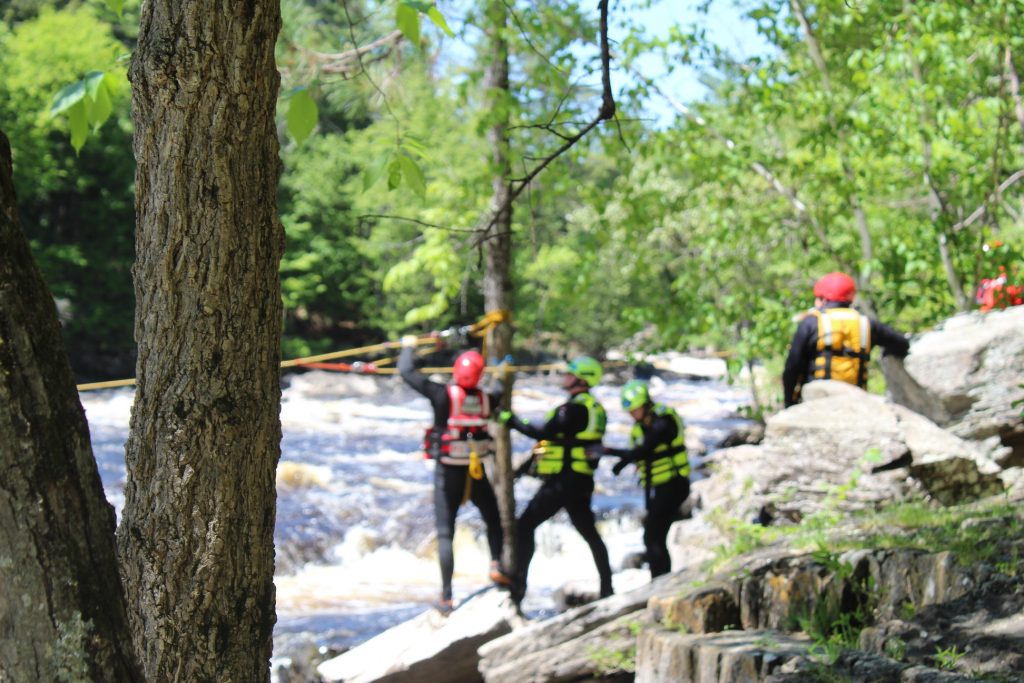
The Operations course is where most teams start their swiftwater journey. It’s hands-on and focused on building confidence and competence in real-world rescue scenarios. Participants learn to think like rescuers — reading currents, making quick decisions, and working safely as a team — while practicing the fundamental techniques that save lives. With practical exercises, simulated rescues, and plenty of in-water drills, this course gives students a strong foundation and the assurance they need to handle many river and flood incidents safely and effectively.
The day is spent in the classroom covering:
The day is spent on site for hands-on training:
Our 16 hour class is NFPA compliant.
The Technician course takes your skills to the next level, challenging students with faster water, more advanced rigging, and dynamic rescue scenarios. Building on Operations-level knowledge, this course pushes participants to think critically, move efficiently, and execute rescues under realistic conditions. With scenario-driven exercises, highline systems, and demanding swim-based rescues, students leave the course prepared to tackle higher-risk swiftwater situations. Completion of Operations and a 1,000-foot open water swim are prerequisites — ensuring participants are ready for the physical and mental demands of this advanced training.
Pre-requisites: NFPA Operations level certification and successful completion of an in-class 1000′ endurance swim
A practical skills test completes the 16 hour class at the end of the second day.
Students are required to supply their own PPE.
Our 16 hour class is NFPA compliant.
We understand that every department faces unique water rescue challenges. That’s why we can—and have—designed hybrid, department-specific courses to meet specialized needs. Examples include lake rescues with boat-based patient transfers, low-head dam operations, gorge or restricted-access water rescue, and other scenario-driven training tailored to your equipment and local hazards. If your team has a particular focus or challenge, we’ll work with you to create a class that delivers exactly what your department needs, where you need it.
Contact us and let’s discuss your team’s unique training needs!